Hay iglesias que son trincheras
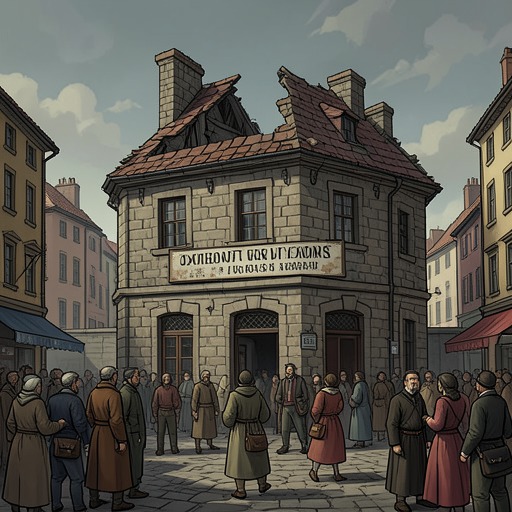
La piel del tambor“Hay iglesias que son trincheras” (“Some Churches Are Trenches”) is both a description of Nuestra Señora de las Lágrimas and a challenge to the authority that would govern its fate. Father Príamo Ferro first uses the image to describe a parish sheltering people from what he calls falsehood; Father Óscar Lobato later turns it against the institution itself, arguing that the Church must defend the people it serves from the Church’s own habits of submission and silence. The phrase gathers the novel’s material conflict over demolition, its ecclesiastical struggle over discipline, and its deeper question about whether faith is doctrine or consolation into one image of refuge under pressure.
Ferro’s Image of a Parish Under Siege
The phrase first comes into focus in a conversation between Ferro and Lorenzo Quart. Having heard the priest’s account of ministry among the suffering, Quart understands that he possesses little practical authority over the stubborn parish priest. Ferro then calls his church a refuge, a trench. Quart responds with irony, treating the image as picturesque, and asks what the trench faces. Ferro’s answer is blunt: it stands against lies and nonsense. The exchange turns a military metaphor into an accusation. The threat is not defined as a single enemy outside the church; it is a surrounding world of deception against which the parish claims to shelter its people.
That claim is inseparable from the parish’s precarious physical survival. Archbishop Aquilino Corvo explains that the church cannot be secularized for demolition while the terms of a papally sanctioned privilege from 1687 remain in force. The privilege requires a Thursday Mass for the soul of Gaspar Bruner de Lebrija, the benefactor who endowed the church. Ferro’s repeated celebration of the Mass therefore becomes more than a devotional observance: it is the condition preserving the building’s ecclesiastical status. The trench is not merely symbolic. Its walls and continuing rites stand between a vulnerable parish and the threatened demolition of its home.
The institution’s response makes the conflict more complicated than a simple contest between faith and secular power. Corvo says he has sought Ferro’s suspension from office, while acknowledging that the process is slow and that Rome is waiting for Quart’s report. Quart has been sent to Seville to identify the author of a letter and handle the matter discreetly with local church authorities. The parish’s protection depends on a ritual condition, but the priest who maintains that condition is himself under ecclesiastical scrutiny. The trench shelters its congregation while leaving its defender exposed to the discipline of the hierarchy.
Lobato Turns the Metaphor Inward
When Quart later speaks with Óscar Lobato, the phrase returns with a changed emphasis. Quart remembers Ferro’s formulation and asks Lobato what churches are supposed to defend themselves against. Lobato walks to a window, draws back the curtains, and answers that they must defend themselves against the Church. He charges the institution with betraying its original message, tracing losses of influence among Europeans, workers, young people, and women. His forecast is of mice running among empty pews: an image of institutional survival reduced to an abandoned building.
Lobato’s version of the trench is directed against submission and silence—the very things he believes Quart has been sent to bring. He describes seminary life as a system organized around forms, ambition, and compromise, in which young priests select patrons who can advance them. His self-accusation matters: he says he once participated in those calculations and failed to give people the sign of hope they needed. The trench is thus not a claim that the Church’s walls or official authority are inherently protective. It names a defensive moral position against a system that, in Lobato’s view, has put obedience and advancement ahead of pastoral care.
The two priests share the metaphor without making the same argument. Ferro’s brief, abrasive answer opposes the parish to the lies and nonsense surrounding it; Lobato gives the image a more explicit institutional target. Ferro’s trench is the church as refuge. Lobato’s is a line of resistance drawn inside the Church, against its complicity in silencing the people it should serve. Their formulations converge in their distrust of empty authority, but the difference between them preserves a tension: the threatened institution can be at once a place of shelter and an instrument from which shelter is needed.
Ritual, Vulnerability, and the Price of Protection
The Thursday Mass makes the metaphor tangible and unusually fragile. Macarena Bruner explains that a representative of the archbishop and a notary paid by Pencho Gavira sit in the back row each Thursday, waiting for an irregularity or lapse. The Mass must be held at eight in the morning on the day of the week when Gaspar died, in 1709. If the priest failed to say it or neglected its required form, the protection could be lost and the church could be demolished. An inherited privilege has become a narrow defensive line maintained by ritual repetition, while two observers watch for the moment it might fail.
This arrangement explains Macarena’s fear about what might happen if Lobato is removed and Ferro is left more exposed. The church’s preservation does not follow automatically from its value to the congregation or from the priest’s personal conviction; it depends on a precise religious obligation being carried out within a contested institutional and property framework. The trench is therefore both refuge and vulnerability. It offers a place where the faithful may find comfort, yet its continued existence rests on a condition that its opponents monitor closely.
Ferro’s defense of the church extends beyond its legal protection to the people who use it. In a later conversation with Quart, he argues that his own uncertainty about faith does not cancel the faith of those who come to him. Their belief, he says, is reason enough for Nuestra Señora de las Lágrimas to exist. He connects that pastoral purpose to the church’s Baroque art: its carvings, gilding, and lavish altars address feeling rather than requiring each worshipper to solve theological questions. For Ferro, an excess of analysis can rob people of hope; the church offers firm ground against a torrent. His defense of the trench is consequently not a straightforward assertion of doctrinal certainty. It rests on the consolation and shelter the parish provides, even when its priest cannot claim certainty for himself.
A Shared Image, Not a Settled Answer
Lobato’s account of faith clarifies why a church could matter even when its institution disappoints. He says that meeting Ferro taught him to understand faith as independent of whether God exists: a blind leap into the arms of someone who receives the frightened, and a comfort before incomprehensible fear and pain. That formulation closely approaches Ferro’s practical defense of the parish. The church’s worth lies not only in what it teaches but in the human need it meets—in the presence offered to people who are afraid, grieving, or dying.
Ferro’s own account of his ministry gives that need its weight. At sixty-four, he says, what he knows of human beings is that they remember, fear, and die. For years he sought an answer from God while accompanying people through suffering, often as their sole comfort, and received no reply. He nevertheless insists that faith can remain a form of hope in a world marked by death and apparent meaninglessness. The contrast between unanswered prayer and continued pastoral service keeps the image of the trench from collapsing into easy certainty: its defender may doubt, yet still guard a place where others find consolation.
When Quart and Ferro later speak beneath the night sky, Ferro argues that awareness of human smallness need not end in despair. Against the vastness of the universe, he allows that a friendly hand may still provide resignation and comfort before everything is over. This final emphasis echoes both versions of the trench: protection is not victory over mortality or institutional decline, but the possibility of being received rather than left alone. The phrase remains deliberately double-edged. A church may defend people from a hostile world, and it may need to defend them from its own hierarchy; its strongest justification, in Ferro’s and Lobato’s converging accounts, is the refuge it gives those who have nowhere else to turn.